implement workforce governance hr department
How to Implement Workforce Governance in HR Departments
How to Implement Workforce Governance in HR Departments ! HR manager reviewing governance policy document Workforce governance in HR is defined as the structured system of policies, decision rights, accountability mechanisms, and oversight processes that ensure consistent, compliant, and transparent workforce management.
How to Implement Workforce Governance in HR Departments
Workforce governance in HR is defined as the structured system of policies, decision rights, accountability mechanisms, and oversight processes that ensure consistent, compliant, and transparent workforce management. To implement workforce governance in an HR department effectively, leaders must align three operational layers: strategic policy design, day-to-day process execution, and continuous compliance monitoring. The EU AI Act now classifies AI used in employment decisions as high-risk, adding regulatory urgency to governance programs that were previously treated as internal best practice. Organizations that embed governance directly into HR workflows, rather than maintaining it as a separate policy document, achieve compliance as a byproduct of normal operations. Guardiahr reports an 87% compliance posture score across its governed client environments, demonstrating what structured implementation produces in practice.
What foundational elements do you need before implementing workforce governance?
The prerequisites for workforce governance fall into four categories: defined roles, data classification, technology infrastructure, and cross-functional partnerships. Skipping any one of these creates gaps that surface during audits.
Defining governance roles
Clear role definitions are the single most critical prerequisite. Three roles carry the work:
-
Data Owners hold business decision accountability for specific workforce data sets, such as compensation records or performance ratings.
-
Data Stewards manage daily custody of that data, including quality checks and access requests.
-
Data Custodians sit in IT or security and control the technical infrastructure where data lives.
Without boundaries between these three roles, compliance checks are routinely neglected. Assign named individuals, not teams, to each role before any governance policy goes live.
Data classification and technology requirements
Workforce data requires sensitivity tiers. At minimum, classify data as public, internal, confidential, or restricted. Compensation data, health records, and immigration documents belong in the restricted tier and require access controls that limit visibility to named roles only.
Technology requirements include workflow automation, role-based access control, and audit logging. Governance without these tools forces manual follow-up, which fails at scale. Cross-functional collaboration among HR, IT, Legal, and Compliance is not optional. Each function owns a distinct piece of the governance chain, and coordinated cross-departmental ownership is what enables safe scaling rather than slowing it.
- Prerequisite: Role definitions · Owner: HR + Legal · Minimum Requirement: Named Data Owners, Stewards, Custodians
- Prerequisite: Data classification · Owner: HR + IT · Minimum Requirement: Four-tier sensitivity schema
- Prerequisite: Access control system · Owner: IT + HR · Minimum Requirement: Role-based permissions with audit log
- Prerequisite: Cross-functional charter · Owner: HR + Compliance · Minimum Requirement: Signed governance responsibility matrix
- Prerequisite: Regulatory mapping · Owner: Legal + Compliance · Minimum Requirement: Applicable laws and AI Act obligations
How do you structure workforce governance into everyday HR operations?
Effective HR governance frameworks operate on three layers: strategic alignment, operational execution, and compliance monitoring. Each layer requires distinct ownership and distinct outputs.
The strategic layer sets policy. The operational layer embeds those policies into hiring workflows, performance management cycles, and compensation reviews. The monitoring layer audits whether the operational layer is actually following the strategic layer. Most organizations build the strategic layer and skip the other two. That is where governance fails.
Embedding governance in core HR workflows
Governance becomes durable when it is built into the processes HR teams already run. Three workflows carry the most risk and deserve the most attention:
-
Hiring: Every job requisition should trigger a documented approval chain. AI-assisted screening tools require a written record of human review for each recommendation. The EU AI Act mandates documented human oversight for every automated hiring decision, with written justification when a recommendation is overridden.
-
Performance management: Rating calibration sessions should follow a documented protocol that defines who can adjust scores and under what conditions. This prevents manager discretion from becoming a compliance liability.
-
Compensation: Pay decisions require a documented decision-rights matrix that specifies who proposes, who approves, and who audits. Shared approval authority with no named accountable party is the most common governance failure in compensation cycles.
Governing AI tools in HR
The EU AI Act classifies AI used in employment as high-risk, with non-compliance penalties reaching 35 million EUR or 7% of global annual turnover. That regulatory exposure makes AI governance a board-level concern, not just an HR operations task. Every AI tool used in hiring, scheduling, or performance assessment needs a governance checklist that documents the use case, the data inputs, the bias check methodology, and the review cycle. Guardiahr’s AI governance capabilities are designed to support exactly this documentation requirement.
Pro Tip: Assign a single named AI governance owner in HR, not a committee. Committees diffuse accountability. One named owner with a defined escalation path produces faster decisions and cleaner audit trails.
What are the step-by-step actions to implement workforce governance in 90 days?
A practical HR governance framework deploys in 90 days using five phases: catalog, classify, control, check, and change. Each phase has a measurable exit criterion.
-
Catalog (Weeks 1–2): Inventory every workforce data set, every HR system, and every AI tool in use. Document who currently has access to what. This step surfaces shadow systems and undocumented data flows that create audit risk.
-
Classify (Weeks 3–4): Apply the four-tier sensitivity schema to every data set identified in the catalog. Assign a named Data Owner to each data set. Flag any data set that falls under the EU AI Act or other applicable regulations.
-
Control (Weeks 5–8): Implement role-based access controls, configure workflow automation for approval chains, and activate audit logging. By the end of Week 8, organizations should reach at least 90% completion on initial access reviews. That benchmark is the standard exit criterion for this phase.
-
Check (Weeks 9–10): Run the first internal compliance audit. Test every access control against the classification schema. Verify that every AI tool has a documented oversight model with named human reviewers. Collect evidence for each control.
-
Change (Weeks 11–12): Close gaps identified in the check phase. Update policies to reflect what the audit revealed. Communicate changes to all affected stakeholders with a documented escalation path for questions.
- Phase: Catalog · Weeks: 1–2 · Exit Criterion: All data sets and systems documented
- Phase: Classify · Weeks: 3–4 · Exit Criterion: Sensitivity tiers and Data Owners assigned
- Phase: Control · Weeks: 5–8 · Exit Criterion: 90% of access reviews completed
- Phase: Check · Weeks: 9–10 · Exit Criterion: First internal audit completed with evidence
- Phase: Change · Weeks: 11–12 · Exit Criterion: Gaps closed and policies updated
Training requirements
Role-specific governance training is mandatory, not optional. HR professionals need training on data privacy obligations and bias detection. Managers need training on human override documentation and employee rights to human review. Employees need training on what data is collected, how it is used, and how to request corrections. Training that covers policy without practical drills produces governance that looks good on paper but fails under audit pressure.
Pro Tip: Run a tabletop override drill with managers before the system goes live. Present a scenario where an AI tool recommends rejecting a candidate, and require each manager to document their review decision in writing. The drill reveals training gaps before they become compliance violations.
How do you monitor and maintain workforce governance over time?
Governance is not a project with an end date. Strategic workforce planning stays effective only when treated as a living process with quarterly reviews, not a one-time deliverable. The same principle applies to governance.
Routine maintenance requires four ongoing activities:
-
Quarterly compliance audits: Review access logs, override records, and AI tool outputs against the governance checklist. Collect evidence for each control point. Document findings and assign remediation owners.
-
Performance tracking: Measure governance health with specific metrics: percentage of access reviews completed on schedule, number of undocumented AI decisions, and time to close audit findings.
-
AI tool reviews: Every AI tool in HR requires a regular audit cycle that checks for model drift, bias in outputs, and alignment with current regulatory requirements. Quarterly is the minimum cadence under the EU AI Act for high-risk systems.
-
Policy updates: Governance policies must reflect current regulatory requirements. Assign a named policy owner who monitors regulatory changes and triggers updates when the law changes.
Governance without practical competence and targeted training is merely performative and leaves organizations legally vulnerable despite policies being in place.
The most common reason governance programs lose momentum is that no one owns the monitoring function after the initial rollout. Assign a named governance lead with a defined reporting line to the CHRO. That single structural decision sustains governance programs through leadership changes and organizational restructuring.
Key Takeaways
Workforce governance succeeds when it is embedded in operational workflows, owned by named individuals, and audited on a defined schedule.
- Point: Define roles before policies · Details: Assign named Data Owners, Stewards, and Custodians before writing any governance policy.
- Point: Use the five-phase model · Details: Catalog, classify, control, check, and change delivers a governed HR environment within 90 days.
- Point: Embed governance in workflows · Details: Build approval chains and documentation requirements into hiring, performance, and compensation processes.
- Point: Govern AI tools explicitly · Details: Every AI tool in HR needs a documented oversight model with named human reviewers and a quarterly audit cycle.
- Point: Monitor with named ownership · Details: Assign a governance lead with a CHRO reporting line to sustain compliance after the initial rollout.
Workforce governance works when it stops being a document
After working with HR governance programs across complex organizations, the pattern that separates functional governance from performative governance is always the same: the organizations that succeed treat governance as an operational system, not a policy library.
The instinct in most HR departments is to write a thorough governance policy, get it approved, and consider the work done. That approach produces a document that no one reads and an audit that reveals gaps everywhere. The organizations that actually maintain compliance build governance into the systems people use every day. The approval chain is in the workflow tool. The access request goes through a defined process. The override documentation is a required field, not an optional note.
The AI governance piece is where I see the most risk right now. The EU AI Act’s requirements for documented human oversight are specific and auditable. Most HR teams understand the concept of human review but have never practiced what it looks like to document a decision to override an AI recommendation in writing. That gap between understanding and practice is exactly what regulators will test. Running override drills before a system goes live is the single most underused preparation step I have seen.
The other structural mistake is treating governance as an HR-only function. Legal, IT, and Compliance each own a piece of the chain. When HR tries to govern alone, the access controls are incomplete, the regulatory mapping misses obligations, and the audit trail has holes. Cross-functional ownership is not a coordination burden. It is what makes governance hold up under scrutiny.
— Luka
How Guardiahr supports workforce governance implementation
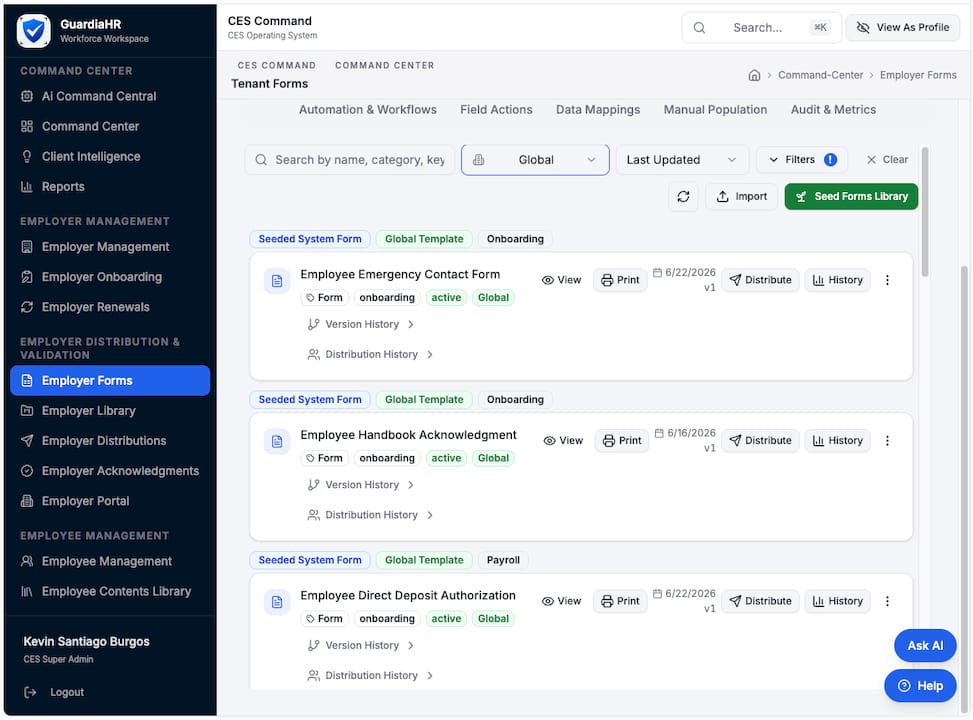
Guardiahr is built for the operational reality of workforce governance, not just the policy layer. Its role-based administration maps directly to the Data Owner, Steward, and Custodian model, so access control reflects actual governance accountability rather than generic permissions.
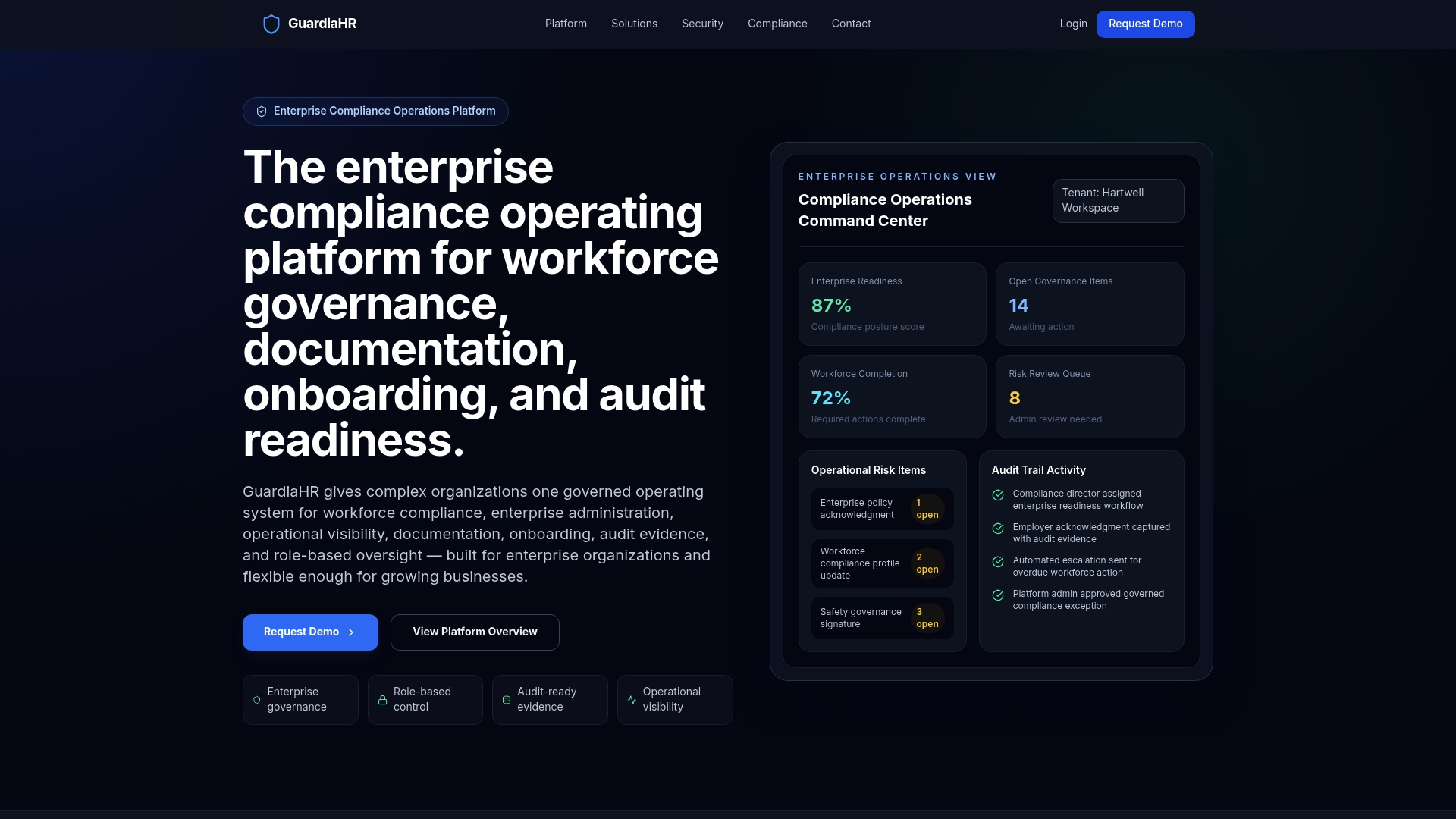
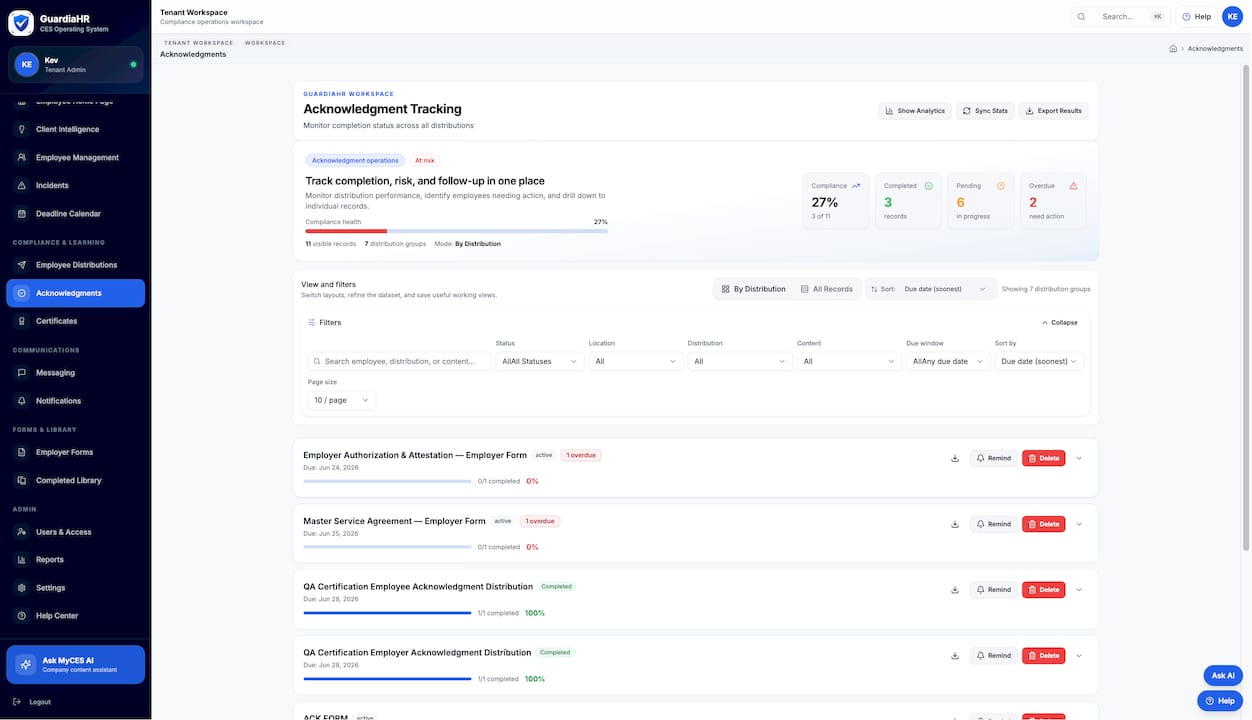
Automated compliance checkpoints embed governance controls into HR workflows, turning approval chains and documentation requirements into system-enforced steps rather than manual reminders. The platform’s audit log captures every access event, override decision, and policy acknowledgment, producing the evidence trail that quarterly audits require. Guardiahr reports an 87% compliance posture score across its governed environments. For HR teams building or rebuilding their governance program, that operational infrastructure removes the manual follow-up burden that causes most governance programs to stall after the initial rollout.
FAQ
What is an HR governance framework?
An HR governance framework is the structured set of policies, decision rights, accountability roles, and oversight mechanisms that govern how an organization manages its workforce. It operates across three layers: strategic alignment, operational execution, and compliance monitoring.
How long does it take to implement workforce governance?
A practical HR governance framework deploys within 90 days using a five-phase approach: catalog, classify, control, check, and change. By Week 8, organizations should complete at least 90% of initial access reviews.
What roles are required for HR data governance?
Three roles are required: Data Owners who hold business accountability, Data Stewards who manage daily data custody, and Data Custodians in IT who control the technical infrastructure. Without named individuals in each role, compliance checks are routinely neglected.
Does the EU AI Act apply to HR departments?
The EU AI Act classifies AI used in employment decisions as high-risk, requiring quarterly compliance audits and documented human oversight for every automated recommendation. Non-compliance penalties can reach 35 million EUR or 7% of global annual turnover.
What is the most common reason workforce governance programs fail?
Governance programs fail most often when frameworks remain static documents separate from daily workflows. Embedding governance controls directly into hiring, performance management, and compensation processes prevents this by making compliance a byproduct of normal operations rather than an additional burden.